Insight Archives - Susi In

Insight

Insight

Load Balancing with Switches and Servers: Optimizing Performance and Scalability

In modern network environments, where high availability and optimal performance are paramount, load balancing plays a crucial role. Load balancing distributes network traffic across multiple servers, ensuring efficient utilization of resources, improving response times, and maximizing scalability. This article explores the relationship between switches, servers, and load balancing, highlighting the benefits and best practices for implementing load balancing techniques to optimize performance and scalability. Understanding Load Balancing Load balancing involves the distribution of incoming network traffic across multiple servers to prevent any single server from becoming overwhelmed with excessive requests. By balancing the workload, load balancers ensure that no server is overloaded, enhancing performance and preventing potential bottlenecks. Load balancers operate at the application layer (Layer 7) of the OSI model, intelligently distributing traffic based on various algorithms, such as round-robin, least connections, or response time. The Role of Switches in Load Balancing Switches play a critical role in load balancing by providing the necessary connectivity and network infrastructure. They enable the seamless communication between load balancers and servers, acting as intermediaries for traffic distribution. Switches with advanced features, such as high-speed interfaces, low latency, and traffic management capabilities, contribute to an efficient load balancing mechanism, facilitating optimal performance and scalability. Server Redundancy and High Availability Load balancing, in combination with server redundancy, is an effective approach to achieving high availability. By deploying multiple servers and distributing traffic evenly among them, load balancers ensure that if one server becomes unavailable, others can seamlessly handle the incoming requests. Switches facilitate the routing of traffic to available servers, allowing for uninterrupted service even in the event of server failures. This redundancy and failover mechanism ensures continuity and minimizes downtime, enhancing the overall reliability of the network infrastructure. Dynamic Scaling and Elasticity Load balancing enables dynamic scaling and elasticity, allowing organizations to adapt to fluctuating demands. During peak periods, additional servers can be added to the server pool, and load balancers distribute traffic accordingly. This scalability ensures that resources are efficiently utilized, preventing performance degradation and maintaining optimal response times. Switches play a crucial role in enabling the seamless integration of new servers into the network, accommodating the increased traffic load and ensuring smooth operation. Health Monitoring and Load Balancer Integration Effective load balancing requires continuous health monitoring of servers. Load balancers regularly check the health status of servers, ensuring that only healthy servers receive traffic. Switches can be integrated with load balancers to monitor the availability and responsiveness of servers. This integration allows switches to adapt their forwarding decisions based on the health status of servers, further optimizing the load balancing process and ensuring the efficient distribution of network traffic.  Load Balancing Algorithms and Traffic Optimization Various load balancing algorithms can be employed to distribute network traffic intelligently. Round-robin, weighted round-robin, least connections, and least response time are some commonly used algorithms. The choice of the algorithm depends on factors such as server capabilities, traffic patterns, and performance requirements. By carefully selecting and configuring the appropriate load balancing algorithm, organizations can optimize traffic distribution, minimize response times, and enhance the overall user experience. Secure Load Balancing Load balancing mechanisms can be secured by employing secure protocols, such as SSL/TLS, for encrypting traffic between clients, load balancers, and servers. This ensures the confidentiality and integrity of data transmitted over the network. Additionally, switches can be configured to implement access control lists (ACLs) and firewall rules to protect load balancers and servers from unauthorized access or malicious attacks. Firewall Integration for Enhanced Security While load balancing optimizes performance and scalability, it is crucial to maintain a strong security posture. Firewalls play a vital role in ensuring the secure operation of load balancing mechanisms. By integrating firewalls into the network architecture, organizations can enforce security policies, control traffic flow, and protect against unauthorized access or malicious attacks. Firewalls act as a protective barrier between external networks and the load balancers, preventing potentially harmful traffic from reaching the server pool. They examine network packets, filter out malicious requests, and enforce access control rules, bolstering the overall security of the load balancing infrastructure. By combining load balancing with robust firewall configurations, organizations can achieve an optimal balance between performance optimization and network security. Load balancing, with the support of switches and servers, is a critical component in optimizing network performance and scalability. By effectively distributing network traffic across multiple servers, load balancers ensure efficient resource utilization, prevent overloads, and enhance response times. Switches facilitate the seamless integration of load balancers and servers, enabling the efficient routing of traffic. The combination of load balancing techniques, server redundancy, and high availability ensures uninterrupted service and minimizes downtime. By implementing secure load balancing mechanisms and continuously monitoring server health, organizations can achieve optimal performance, scalability, and reliability in their network infrastructure.


Insight

Firewall Configurations for Server Protection : Best Practices for a Secure Network Infrastructure

In the realm of network security, servers hold a crucial position as they provide various services, resources, and data to client devices. Protecting servers from unauthorized access and potential threats is paramount to maintain data integrity, ensure business continuity, and safeguard sensitive information. Firewall configurations play a vital role in establishing a secure network infrastructure that shields servers from malicious activities. Understanding Firewall Functionality Firewalls act as the first line of defense, protecting servers from external threats. They monitor and control network traffic, allowing authorized connections while blocking unauthorized access. By filtering packets based on predefined security rules, firewalls create a secure barrier between an internal network and external networks, such as the internet. It is essential to configure firewalls effectively to maximize server security. Implementing a Default Deny Policy A fundamental principle of firewall configuration is the adoption of a default deny policy. This means that by default, all traffic is blocked unless explicitly permitted. This approach ensures that only authorized connections are established, reducing the attack surface and mitigating the risk of unauthorized access. Each server should have its own set of rules that explicitly allow specific protocols, ports, and IP addresses required for its intended functions. Granular Rule-Based Access Control To achieve fine-grained control over server access, firewall rules should be created based on the principle of least privilege. Each rule should be carefully crafted to allow only the necessary traffic for the server’s intended purpose. It is crucial to regularly review and update firewall rules to remove any unnecessary allowances or to modify access permissions based on evolving security requirements. By adopting this approach, organizations can minimize the potential for unauthorized access and limit the impact of a successful breach. Application Layer Firewalls for Server Security While traditional firewalls operate at the network and transport layers (Layers 3 and 4), application layer firewalls provide an additional layer of protection by inspecting traffic at the application layer (Layer 7) of the OSI model. These firewalls are specifically designed to understand and control application-specific protocols, making them highly effective in preventing attacks targeting server applications. Application layer firewalls can analyze HTTP, FTP, DNS, and other protocols, providing granular control and deep inspection to identify and block malicious traffic. Intrusion Detection and Prevention Systems (IDPS) Integration To bolster server protection, integrating intrusion detection and prevention systems with firewalls is recommended. IDPS solutions monitor network traffic, detect anomalies, and can actively respond to potential threats. By combining the capabilities of firewalls and IDPS, organizations can enhance server security by quickly identifying and mitigating suspicious activities, blocking intrusion attempts, and reducing the risk of successful attacks. Virtual Private Networks (VPNs) for Secure Remote Access In scenarios where remote access to servers is necessary, establishing secure connections is paramount. Virtual Private Networks (VPNs) provide a secure tunnel for remote users to access servers over an encrypted connection. By configuring firewalls to allow VPN connections and implementing proper authentication and encryption protocols, organizations can ensure that remote access to servers is conducted securely, mitigating the risk of unauthorized access or data interception. Logging and Monitoring Effective firewall configurations should include comprehensive logging and monitoring mechanisms. Firewalls should be configured to log relevant events, including connection attempts, blocked traffic, and other security-related activities. These logs can be analyzed in real-time or periodically reviewed to detect suspicious patterns or unauthorized access attempts. By closely monitoring firewall logs, organizations can proactively identify and respond to potential security incidents, strengthening server protection. Regular Auditing and Penetration Testing Periodic auditing and penetration testing of firewall configurations are crucial to ensure their effectiveness. Auditing involves reviewing firewall rules, access permissions, and configurations to identify potential vulnerabilities or misconfigurations. Penetration testing involves simulating real-world attacks to evaluate the resilience of the firewall and server configurations. By conducting regular audits and penetration tests, organizations can identify and address security gaps, further fortifying server protection. Enhancing Server Security and Network Segmentation Switches play a vital role in enhancing server security by facilitating efficient communication and enabling network segmentation. By connecting servers to switches, organizations can establish dedicated connections and optimize data flow between servers and client devices. This not only improves network performance but also helps isolate servers from potential threats. Switches, when combined with VLANs (Virtual LANs), allow for network segmentation, where servers with different security requirements or functionalities can be placed in separate logical networks. This segmentation adds an additional layer of protection, as switches can be configured to restrict traffic flow between VLANs, preventing unauthorized access to critical servers. Thus, switches serve as a crucial component in server protection, supporting efficient communication and enhancing network security through network segmentation. Configuring firewalls to enhance server protection is an essential aspect of building a secure network infrastructure. By implementing a default deny policy, creating granular rule-based access control, and integrating application layer firewalls and IDPS solutions, organizations can establish robust defenses against unauthorized access and potential threats. Secure remote access through VPNs, logging and monitoring mechanisms, and regular auditing and penetration testing further reinforce server protection. By adhering to these best practices and continuously evaluating and improving firewall configurations, organizations can safeguard their servers, maintain data integrity, and ensure the resilience of their network infrastructure in the face of evolving security challenges.

Insight

Network Security Architecture: The Crucial Relationship Between Firewalls, Servers, and Switches

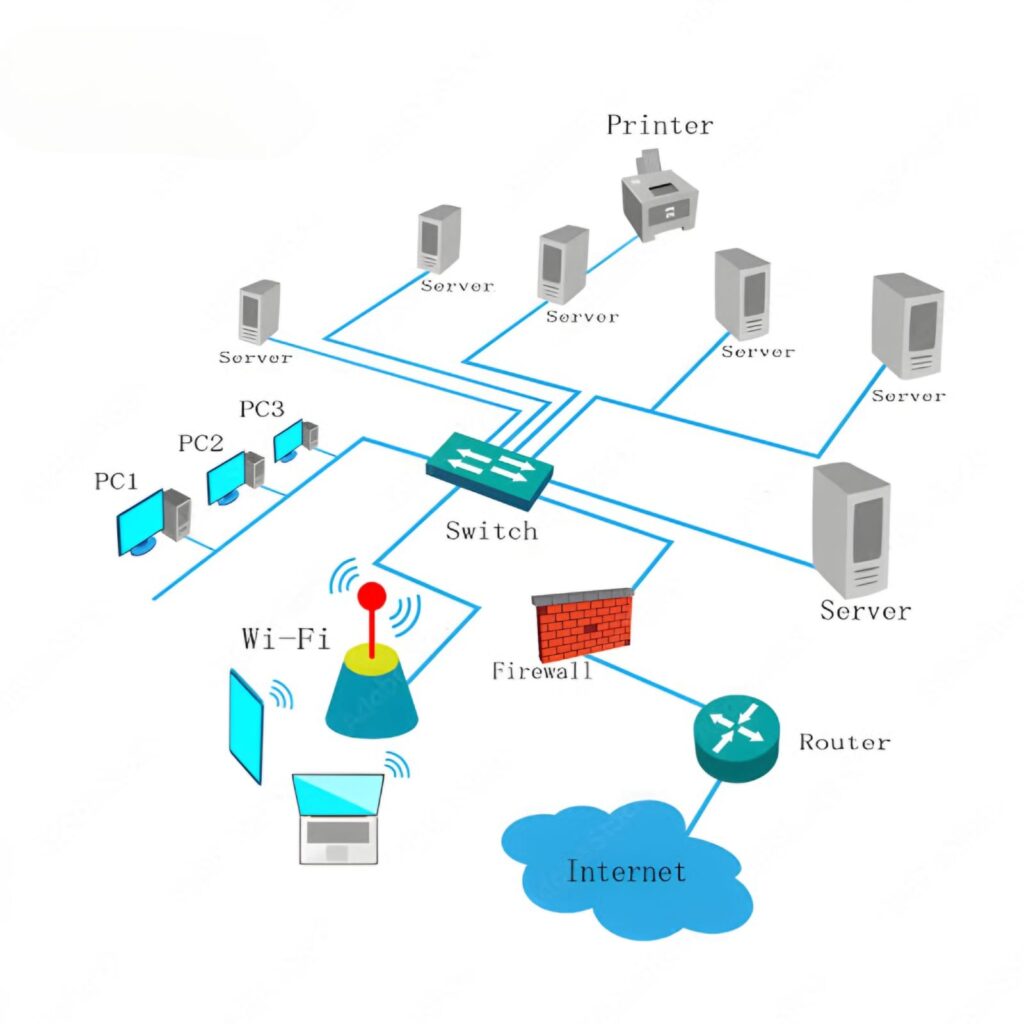
In today’s interconnected world, network security plays a critical role in safeguarding sensitive data, ensuring privacy, and protecting against malicious activities. Three key components that form the foundation of a robust network security architecture are firewalls, servers, and switches. In this article, we will explore the relationship between these components and how they work together to create a secure network infrastructure. Understanding Firewalls A firewall acts as a barrier between an internal network and external networks, such as the internet. Its primary purpose is to monitor and control incoming and outgoing network traffic based on predefined security rules. By inspecting packets and filtering them, firewalls determine whether to allow or block traffic, thereby protecting the network from unauthorized access and potential threats. Firewalls can be deployed as hardware or software solutions and are often strategically placed at the network perimeter. Servers, The Backbone of Network Services Servers are powerful computers or systems that provide various services, resources, and data to client devices within a network. They handle high workloads and offer robust processing capabilities. Servers are responsible for hosting websites, managing databases, storing files, running applications, or providing email services, among other functions. By connecting servers to the network infrastructure, client devices can access and utilize the services and resources they offer. The Role of Switches Switches are essential networking devices that connect multiple devices within a local area network (LAN). They operate at the data link layer (Layer 2) of the OSI model and facilitate communication between devices by forwarding data packets based on Media Access Control (MAC) addresses. Switches create dedicated point-to-point connections between devices, improving network performance and reducing congestion. They ensure that data packets are delivered directly to the intended recipient, optimizing network efficiency. Collaborative Security, How They Work Together Firewalls, servers, and switches work collaboratively to establish a secure network infrastructure. Let’s explore their relationship and how they complement each other: Firewall and Server Integration : Firewalls play a crucial role in protecting servers from unauthorized access and potential threats. By defining security policies and rules, firewalls allow only authorized traffic to reach servers, while blocking malicious attempts. They act as a gateway, monitoring traffic between external networks and servers, ensuring that only legitimate connections are established. Switches Enhancing Server-Client Communication : Switches are responsible for efficiently directing traffic between servers and client devices. By creating dedicated connections, they eliminate network congestion and ensure smooth and efficient communication. Switches optimize the flow of data packets, enhancing server-client interactions and overall network performance. Network Segmentation and Server Isolation : Firewalls and switches can collaborate to implement network segmentation, dividing the network into isolated segments or Virtual LANs (VLANs). VLANs enable the separation of servers based on their functions or security requirements. Firewalls can then be configured to control traffic flow between VLANs, ensuring that sensitive servers remain isolated and secure. Intrusion Detection and Prevention Systems (IDPS) : To further enhance network security, intrusion detection and prevention systems can be integrated with firewalls, servers, and switches. IDPS solutions monitor network traffic, detect suspicious activities, and take proactive measures to prevent intrusions. By working together, these components provide a comprehensive security framework. A strong network security architecture relies on the collaborative efforts of firewalls, servers, and switches. Firewalls act as the gatekeepers, protecting servers from unauthorized access and potential threats. They establish a crucial line of defense by monitoring and controlling incoming and outgoing network traffic. By setting up granular security policies, organizations can ensure that only legitimate connections are allowed, significantly reducing the risk of data breaches and unauthorized access to sensitive servers. Servers, as the backbone of network services, provide critical resources and services to client devices. They handle high workloads, process requests, and store and manage valuable data. By integrating firewalls and switches, servers can be safeguarded from external threats, ensuring the confidentiality, integrity, and availability of the services they offer. This collaborative approach ensures that servers remain secure and can perform optimally, meeting the demands of users within the network. In conclusion, the relationship between firewalls, servers, and switches is essential for establishing a robust and secure network infrastructure. Firewalls protect servers from unauthorized access, while switches optimize communication and traffic flow between servers and client devices. By implementing comprehensive network security measures and best practices, organizations can create a resilient architecture that safeguards sensitive data, ensures business continuity, and mitigates the ever-evolving threats in the digital landscape. The collaboration of firewalls, servers, and switches forms the foundation for a secure network, enabling organizations to navigate the complexities of modern technology with confidence and peace of mind.

Scroll to Top